
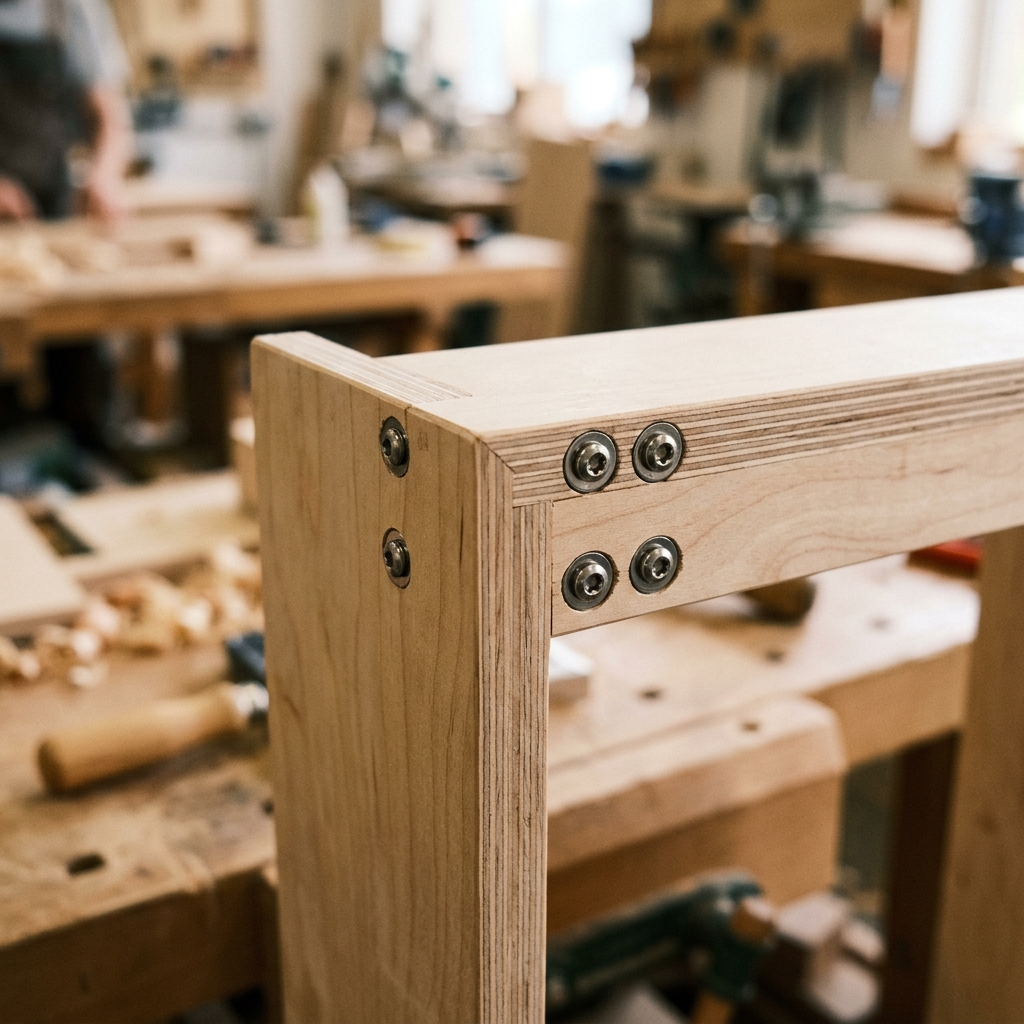
Carcass & Construction
The Strength Behind the Beauty.
Your kitchen is only as strong as the structure you cannot see.
Step 01 — Material Selection
It begins with choosing right.
We begin by selecting materials appropriate for different applications within the kitchen. Board thickness is not a one-size decision — it is selected according to the component and the job it must do.
Step 02 — Plywood Lamination
Built from carefully bonded layers.
Our plywood components are laminated using adhesive and pressed under controlled pressure to create a strong, stable construction — plywood sheets, 0.8 mm laminate and high-grade adhesive, brought together deliberately.
- Plywood sheets — selected per application
- 0.8 mm laminate on both faces
- High-grade adhesive bonding
- Controlled pressing
Panel Cross-Section
Laminate, adhesive and plywood — bonded under controlled pressure.
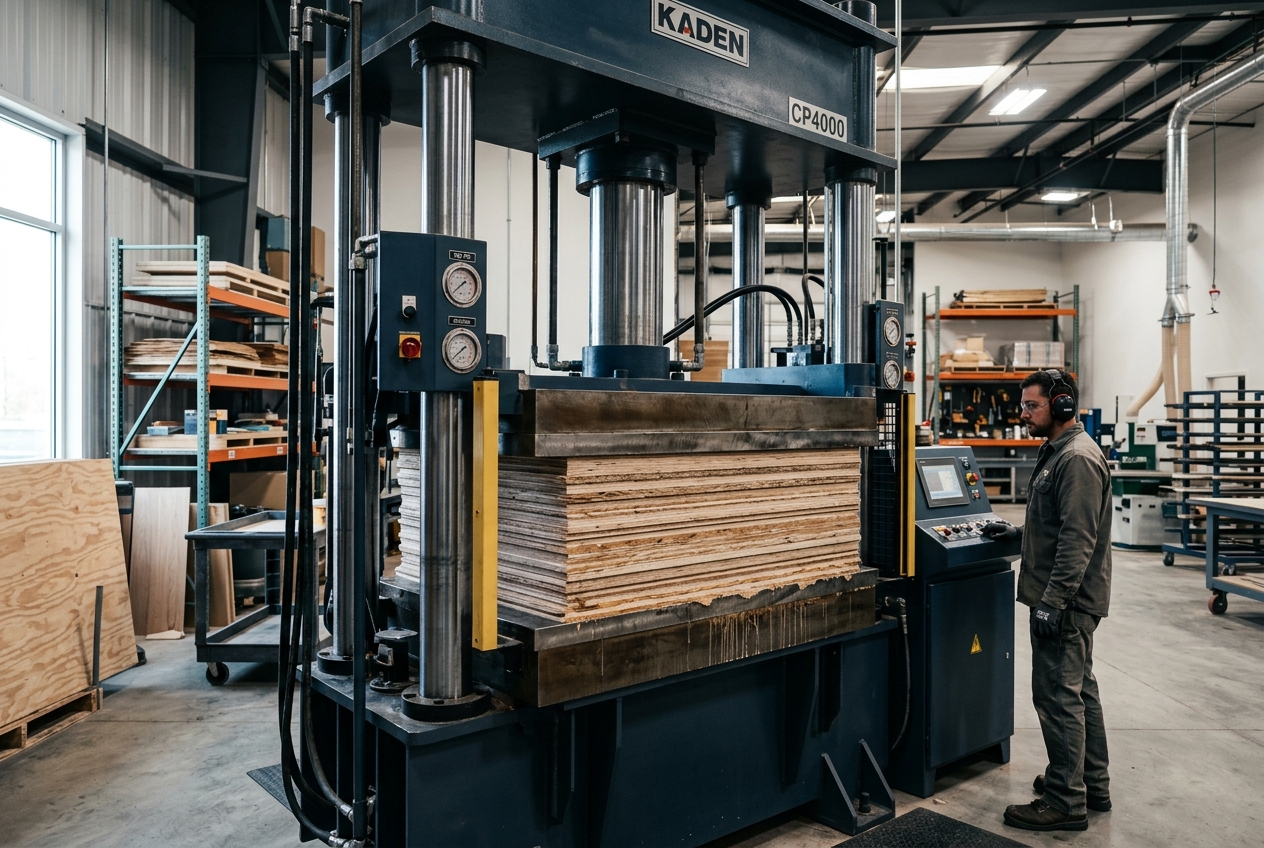
Step 03 — Hydraulic Cold Pressing
Pressure that builds strength.
Laminated plywood sheets are kept overnight under a 50-ton automatic hydraulic cold press machine designed specifically for laminating and pressing.
This controlled pressing helps achieve consistent bonding across the panel and a stable, well-bonded finished board — the quiet discipline behind a kitchen that holds together for years.
Step 04 — Precision Panel Cutting
Precision at every cut.
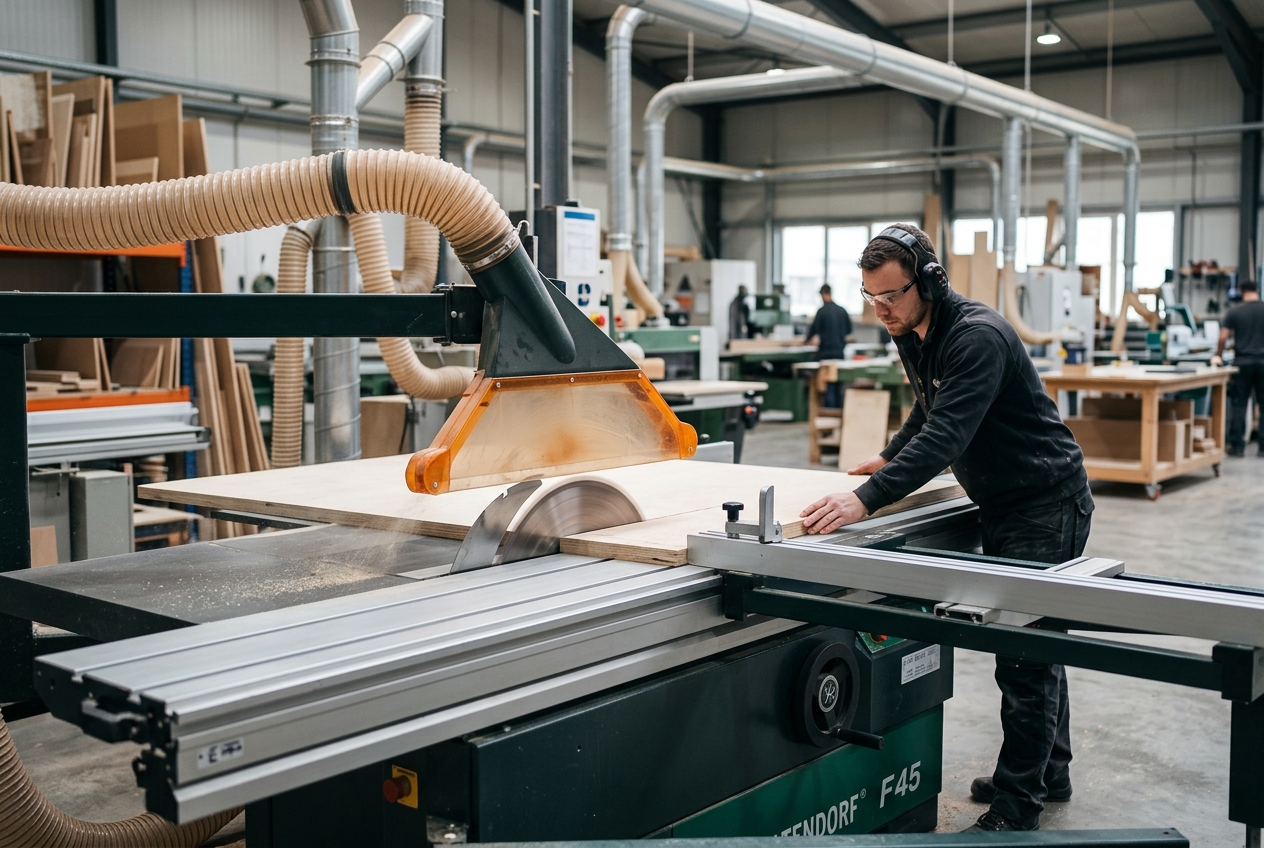
After the pressing process, panels are precisely cut using a professional panel saw to achieve accurate dimensions and clean cutting.
Our cutting process is designed to minimise chipping and improve dimensional accuracy — so every panel fits the way it was engineered to.
Step 05 — Edge Banding
Every edge matters.
After cutting, the exposed edges of plywood components are processed through an edge-banding machine to provide a clean, protected and finished edge — helping protect the board and improving the appearance of every component.
Before
Edge Banding
After
Carcass Joinery
Beyond minifix assembly.
Many modular kitchens rely heavily on conventional knock-down/minifix-style assembly. Paramount Kitchen focuses on a stronger construction approach using adhesive bonding and high-grade stainless-steel screws for structural assembly.
Typical approach
Conventional Knock-Down Assembly
Standard modular construction commonly uses minifix-style knock-down fittings to join carcass panels.
Our approach
Paramount Engineered Joinery
- High-grade adhesive
- High-grade stainless-steel screws
- Secure structural joining
- Carefully aligned components
Depending on the component and application, Paramount Kitchen uses adhesive bonding and high-grade stainless-steel screws to create secure and durable carcass assemblies.
Base Unit Protection
Protection where it matters most.
Base units are installed with a suitable rebate/detailing approach, and a high-grade WPC sheet is incorporated on top and protective areas to help protect the structure from accidental water seepage from the stone countertop.
Designed to provide additional protection against accidental water exposure in vulnerable areas — not a claim that the kitchen is waterproof.
Signature Engineering
Explore the Carcass.
An engineered kitchen is a stack of decisions you cannot see. Select a layer to understand what it does — and why it matters.
Select any layer to inspect it
Layer 03
Plywood Panel
19 / 16 / 9 mmThe structural core. Plywood in 19 mm, 16 mm and 9 mm thicknesses is selected according to each component and application, using 8 × 4 ft sheets for production.
Part of every Paramount carcass
Paramount Kitchen